Thermal vs. Night Vision: A Professional’s Guide to Seeing in the Dark
setembro 20, 2026 · zhangzhang
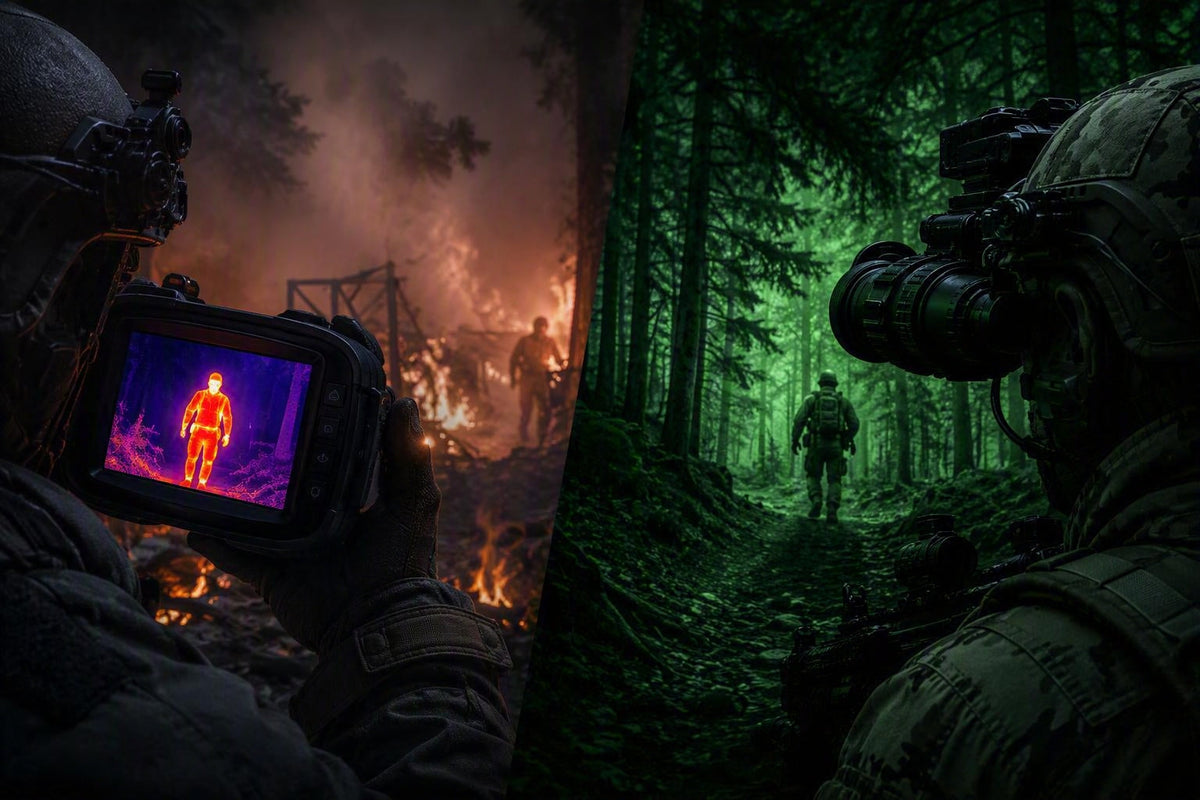
In the world of professional optics, the ability to operate effectively in low-light and no-light conditions is a critical advantage. For decades, two technologies have dominated this space: Night Vision and Thermal Imaging. While often used interchangeably by novices, they are fundamentally different technologies, each with distinct strengths and weaknesses.
Choosing the right tool for the job can mean the difference between success and failure. Whether you’re in law enforcement, conducting search and rescue, managing wildlife, or securing a perimeter, understanding this difference is paramount. At OpticsSupplyPro.com, we don’t just sell equipment; we provide clarity.
How Night Vision Works: Amplifying the Light
Think of a traditional night vision device (NVD) as a powerful light amplifier. It takes the tiny amount of available ambient light—from the moon, stars, or distant artificial sources—and magnifies it thousands of times to produce a visible image.
- The Science: Photons (light particles) enter the device and strike a photocathode, which converts them into electrons. These electrons are accelerated through a microchannel plate, causing a chain reaction that multiplies their number. They then hit a phosphor screen, which converts them back into photons, creating the familiar green-hued image we associate with night vision.
Key Characteristics of Night Vision:
-
Pros:
- Provides a detailed, recognizable image, making it excellent for identification and navigation.
- Can see through glass, which is a significant advantage for vehicle-based observation.
- Offers better depth perception than thermal.
-
Cons:
- Requires some ambient light to function. In absolute darkness (like a sealed cave), it’s ineffective without an infrared (IR) illuminator.
- Can be “whited out” or damaged by sudden bright lights (headlights, flashlights).
- Struggles to see through obscurants like smoke, heavy fog, or thick foliage.
How Thermal Imaging Works: Seeing the Heat
A thermal imager works on a completely different principle. It doesn’t see light; it sees heat. Every object with a temperature above absolute zero emits thermal (infrared) radiation. A thermal device detects these minute temperature differences and translates them into a visual image, called a thermogram.
- The Science: A special lens focuses the infrared energy onto a detector array (a microbolometer). Each detector element reacts to the heat and creates a detailed temperature map. The device’s processor assigns colors or shades of gray to these temperature values, allowing you to see the heat signature of objects, animals, and people.
Key Characteristics of Thermal Imaging:
-
Pros:
- Works in total darkness and is completely passive (emits no energy).
- Excels at detection, as warm bodies stand out dramatically against cooler backgrounds.
- Can see through smoke, dust, fog, and camouflage, making it superior for finding hidden targets.
-
Cons:
- Cannot see through glass (glass blocks long-wave infrared radiation).
- Provides less surface detail, making positive identification more challenging than with night vision.
- Can be affected by “thermal crossover,” a time (usually dawn or dusk) when background and target temperatures are similar, reducing contrast.
Head-to-Head: The Right Tool for the Mission
| Scenario / Task | Winner | Reasoning |
|---|---|---|
| Detecting a hidden person | Thermal | A person’s heat signature is nearly impossible to hide, even in foliage or smoke. |
| Identifying a person’s face | Night Vision | Provides the necessary detail and contrast to recognize facial features. |
| Navigating rough terrain at night | Night Vision | Offers superior depth perception and detail to avoid obstacles. |
| Search & Rescue in a forest fire | Thermal | Can penetrate smoke to find heat signatures of victims or hotspots. |
| Vehicle-based surveillance | Night Vision | Can see through the vehicle’s windows. |
| Operating in a pitch-black cave | Thermal | Requires no ambient light whatsoever to function. |
The Ultimate Solution: Fusion Technology
For professionals who demand the ultimate advantage, fusion technology is the answer. These advanced systems overlay a thermal image on top of a night vision image, combining the superior detection capabilities of thermal with the identification detail of night vision. It’s the best of both worlds, providing unparalleled situational awareness.
Conclusion: Make an Informed Choice
The debate isn’t about “Thermal vs. Night Vision” in terms of which is better overall. The critical question is: What is your primary objective?
- If you need to detect a potential target quickly, especially in challenging conditions, Thermal is your tool.
- If you need to identify that target and navigate your environment with precision, Night Vision is your choice.
At OpticsSupplyPro.com, our team of experts understands these nuances. We don’t just list specs; we help you analyze your mission requirements to ensure you invest in the technology that will give you the decisive edge.
Ready to master the darkness? Explore our curated collection of professional-grade Thermal Imaging and Night Vision systems, or contact our specialists for a personalized consultation.